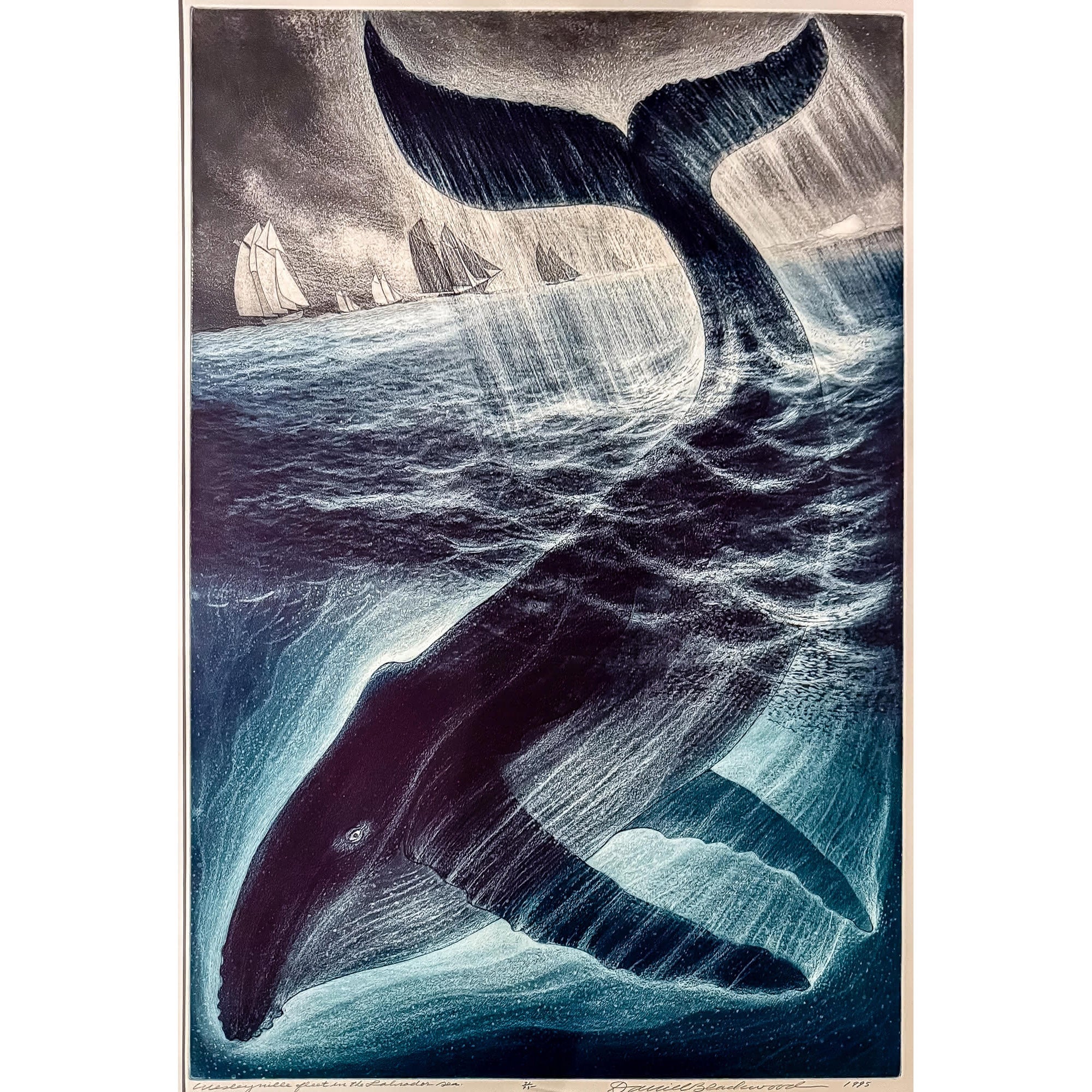
Wesleyville Fleet in the Labrador Sea1995
Proudly Canadian
West End Gallery is a proudly Canadian business, celebrating the incredible talent of artists from coast to coast. For five decades, we have championed Canadian art and supported the vibrant creative community that makes this country extraordinary.
Edmonton, Alberta · Est. 1975
Founded in 1975, West End Gallery has been a cornerstone of Edmonton's arts community for five decades. Located in the heart of Alberta's capital, we take pride in our deep roots and our commitment to showcasing exceptional artwork from talented artists across Canada.
Wesleyville Fleet in the Labrador Sea | 1995 | Etching 71 of 75
About the Artwork
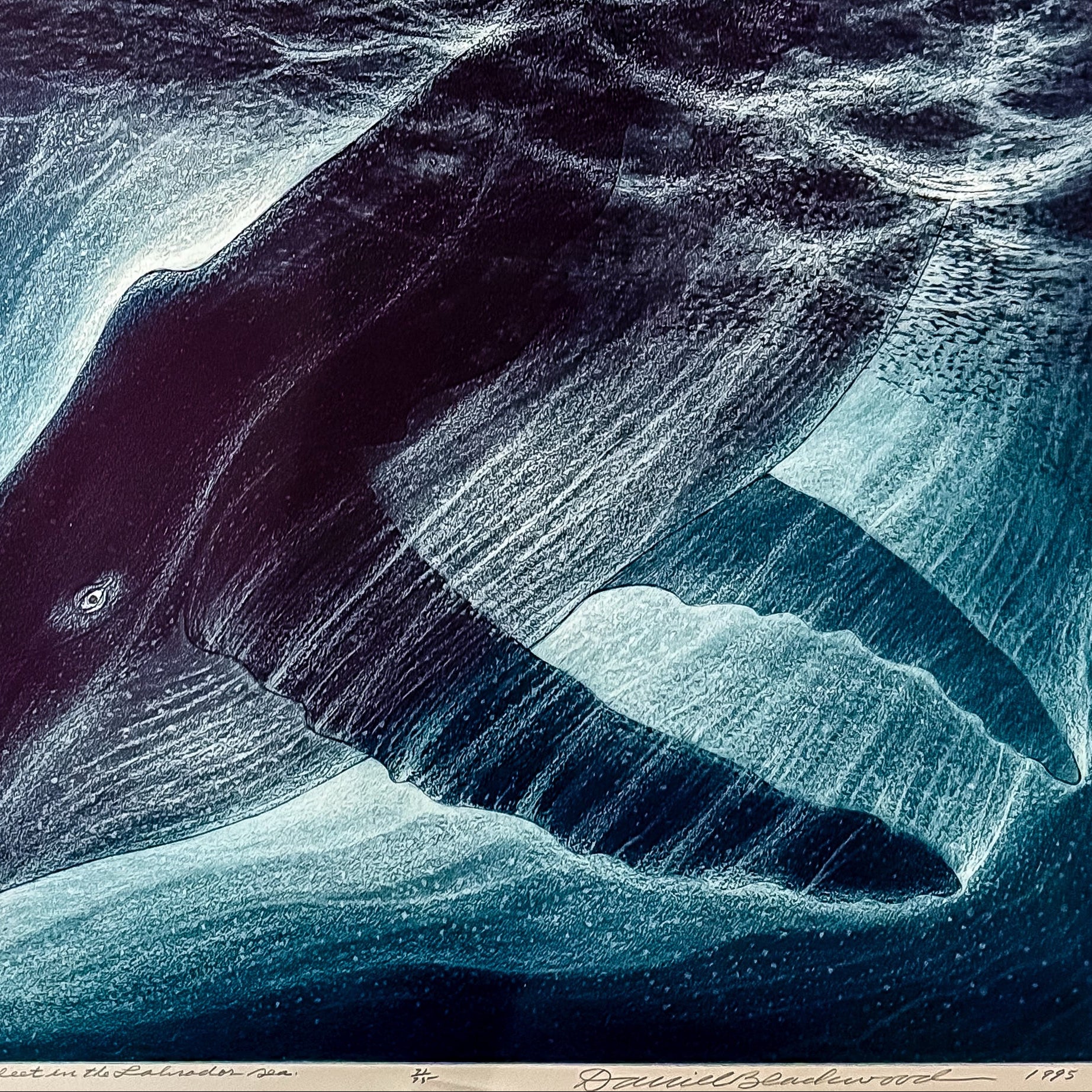
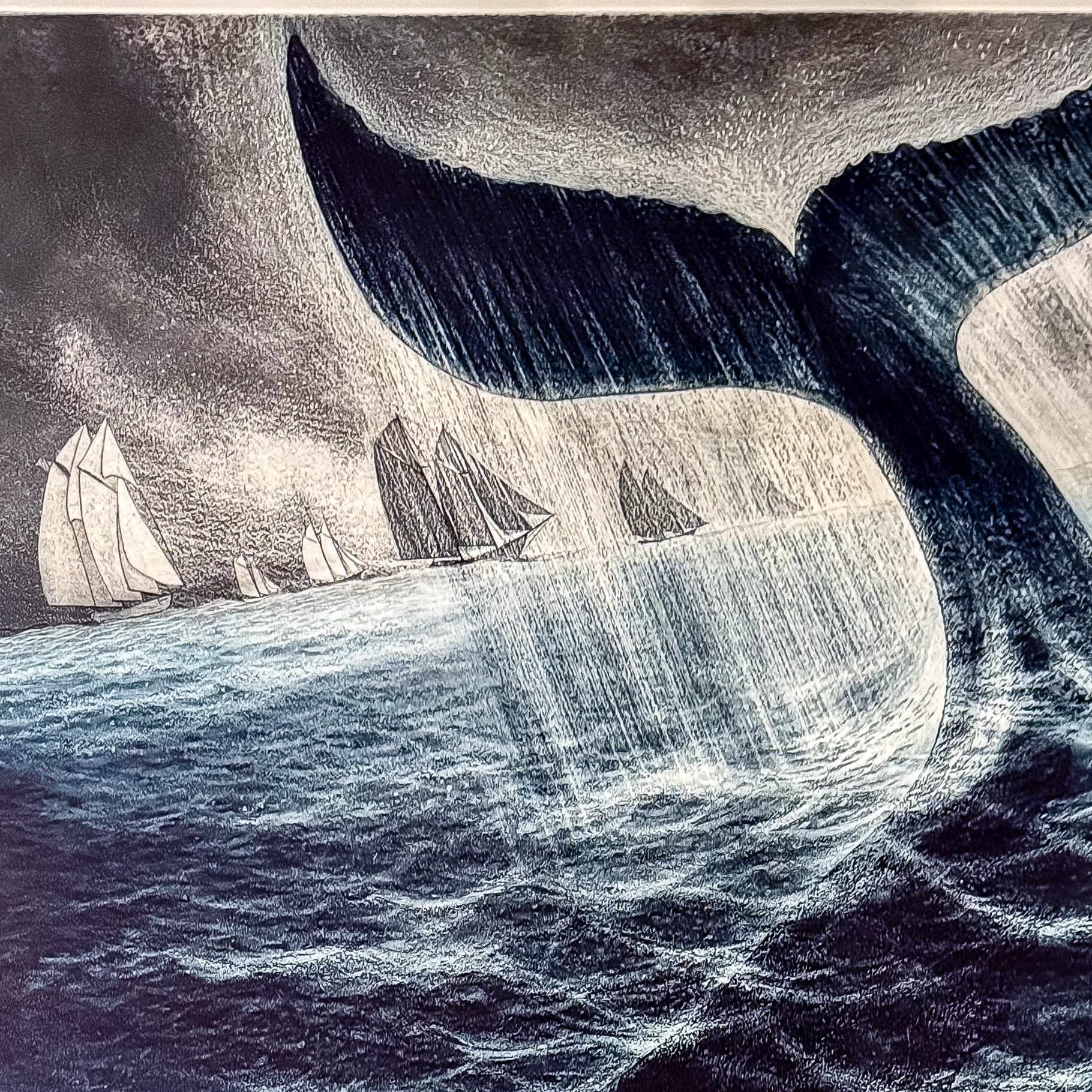
Wesleyville Fleet in the Labrador Sea (1995) is an etching and aquatint by David Blackwood (1941–2022), depicting a humpback whale at the moment its massive tail breaks the surface, with the Wesleyville schooner fleet sailing along the distant horizon. The vertical composition—unusual for maritime subjects—centres on the whale frozen just before impact with the water. The whale's dark body curves downward through gradations of aquamarine, turquoise, and Prussian blue, while white water cascades from its flukes against a grey-violet sky. At the upper horizon, a fleet of sailing schooners representing the Wesleyville fishing fleet appears strikingly small against the creature's immense form. At bottom right, pale ice rises from the depths—a reminder of the Arctic waters these ships navigated.
This scale contrast is intentional and thematically essential. Blackwood's maritime imagery consistently positions humans and their vessels as vulnerable participants in a vast, indifferent natural world. The whale embodies what the artist called "sublime power," while the ships represent generations of Newfoundland outport culture struggling to survive in the North Atlantic.
Blackwood sailed these waters as a child aboard his father Captain Edward Blackwood's schooner, the Flora S. Nickerson. He wrote: "I remember the experience vividly. It is a landscape both mysterious and starkly simple—a region of tremendous, even surreal, contrasts of atmosphere, light and character. Its strange, bleak beauty carries an undercurrent of danger, an undefined threat which seems to lurk just below the surface. Moving through it, men and their ships are dwarfed by mountains of ice and by the immensity of the forces of nature that shaped them. One gets a sense that powers as old as Creation move through this watery dreamscape, and that the whales who spectacularly breach and sound into its black depths are somehow an embodiment of this sublime power."1
Created in 1995, two years after Blackwood received the Order of Canada, this work represents the artist at the peak of his technical mastery—thirty years after graduating from the Ontario College of Art with the Government of France Medal for printmaking. The monumental 36" × 24" format demonstrates the ambitious scale of his mature work.
Dimensions and Details
- Title: Wesleyville Fleet in the Labrador Sea
- Artist: David Blackwood (1941–2022)
- Year: 1995
- Size: 36" × 24" (91.4 × 61 cm)
- Medium: Etching and aquatint on paper
- Edition: 71/75
- Condition: Pristine. These specific impressions have been stored flat in archival conditions since 1995, never displayed or exposed to ambient light.
Acquisition Enquiries
Wesleyville Fleet in the Labrador Sea is offered exclusively through West End Gallery. Serious acquisition enquiries are welcome. We invite you to contact us directly to arrange a private viewing. Layaway options are available upon request. Shipping is quoted based on location; local delivery within Edmonton and surrounding communities is complimentary.
Citations
- David Blackwood, artist's statement on the Labrador Sea, quoted in William Gough, David Blackwood: Master Printmaker (Toronto: McGraw-Hill Ryerson, 2001).
Accessibility Description
This vertical composition depicts a humpback whale at the dramatic moment its tail flukes break the ocean's surface. The whale's massive dark body dominates the centre, curving downward from upper right toward lower left as it dives. The broad tail flukes at the top of the composition send cascades of white water streaming upward and outward against a grey-violet sky, frozen at the instant before the tail strikes the surface. The whale's small eye is visible on its dark flank.
The ocean is rendered in graduated tones moving from surface to depth: grey-violet sky above transitions to turquoise and aquamarine where light penetrates the surface water, deepening through Prussian blue in the middle depths to indigo and near-black in the lowest portions. Fine etched lines throughout create texture suggesting light playing through water and the turbulence of the whale's movement. White streaks and spray patterns emphasize the power of the descent.
At the upper horizon, a fleet of sailing schooners appears—several vessels with white sails visible against the grey sky at the upper left. These ships appear strikingly small compared to the whale's immense form, emphasizing the dramatic scale contrast between human endeavour and natural power. At the bottom right corner, a pale blue-green ice formation rises into the composition, its angular geometric form contrasting with the organic curves of the whale's body.
The overall palette combines warm grey-violet atmospheric tones with cool aquatic blues and greens. The work demonstrates Blackwood's mastery of aquatint technique, with rich tonal gradations achieved through layered etching. The work is signed "David Blackwood," titled "Wesleyville Fleet in the Labrador Sea," dated "1995," and numbered in pencil in the lower margin. Medium: etching and aquatint on paper, 36" × 24" (91.4 × 61 cm).
Full Provenance
- 1995: Created by David Blackwood
- 1995: Edition of 75 published
- 1995–Present: Private collection; never displayed; stored in archival conditions; offered through West End Gallery, Edmonton
Disclaimer
This description has been prepared by West End Gallery using original documentation and current scholarship. Whilst every effort has been made to ensure accuracy, minor variations or additional information may emerge through ongoing research. Prospective purchasers are encouraged to contact us to confirm any details critical to their acquisition decision.
Shipping & Exchanges
SHIPPING
All artwork is professionally crated and shipped via insured courier service. Shipping rates are calculated based on artwork dimensions and destination.
Delivery Methods:
• Local Pickup — Free at our Edmonton gallery (10337 124 Street NW)
• Local Delivery — complimentary within of Edmonton area
• Canada-wide Shipping — Canada Post, Canpar, Purolator or private courier
• US Shipping — DHL Express
• International & Overseas — DHL Express
Final shipping and handling costs will be confirmed with a quote before payment. Delivery times may vary due to weather, supply chain disruptions, or other factors beyond our control.
INSURANCE
Insurance coverage is not included in shipping estimates and is available upon request.
Exchange
We do not offer refunds, however we allow exchange or store credit within 72 hours of receipt, provided the artwork is returned in its original condition and packaging. Read more
Artwork Care
CARING FOR YOUR ARTWORK
Display
Hang artwork away from direct sunlight, heat sources, and air vents. UV exposure causes fading over time — UV-protective glazing is recommended for works on paper and photography. Avoid hanging artwork above fireplaces or in bathrooms where heat and humidity fluctuate.
Cleaning
Dust frames gently with a soft, dry cloth. Never use household cleaners, water, or solvents on the artwork surface. For oil paintings, a soft-bristle brush can be used lightly to remove surface dust. Professional cleaning is recommended for valuable or delicate pieces.
Temperature & Humidity
Maintain a stable environment — ideally 18–22°C (65–72°F) with 40–55% relative humidity. Rapid changes in temperature or humidity can cause warping, cracking, or flaking. In Alberta’s dry climate, a humidifier can help protect your collection during winter months.
Handling & Moving
Always handle artwork with clean, dry hands or cotton gloves. Carry framed works by the sides of the frame — never by the hanging wire. When transporting, wrap in acid-free tissue or soft blankets and keep upright. For valuable pieces, professional art handlers and custom crating are recommended.
Storage
Store artwork upright in a cool, dry, dark space. Use acid-free materials for wrapping. Never store artwork in attics, basements, or garages where temperature and humidity are uncontrolled.
Insurance
We recommend insuring your art collection. An up-to-date appraisal (every 2–3 years) ensures proper coverage. West End Gallery offers professional appraisal services — please enquire for details.
Questions?
Contact us at info@westendgalleryltd.com or 780-488-4892. We’re always happy to advise on the care of your collection.
Choose options

%20is%20an%20etching%20and%20aquatint%20by%20David%20Blackwood%20(1941%E2%80%932022),%20depicting%20a%20humpback%20whale%20at%20the%20moment%20its%20massive%20tail%20breaks%20t...)