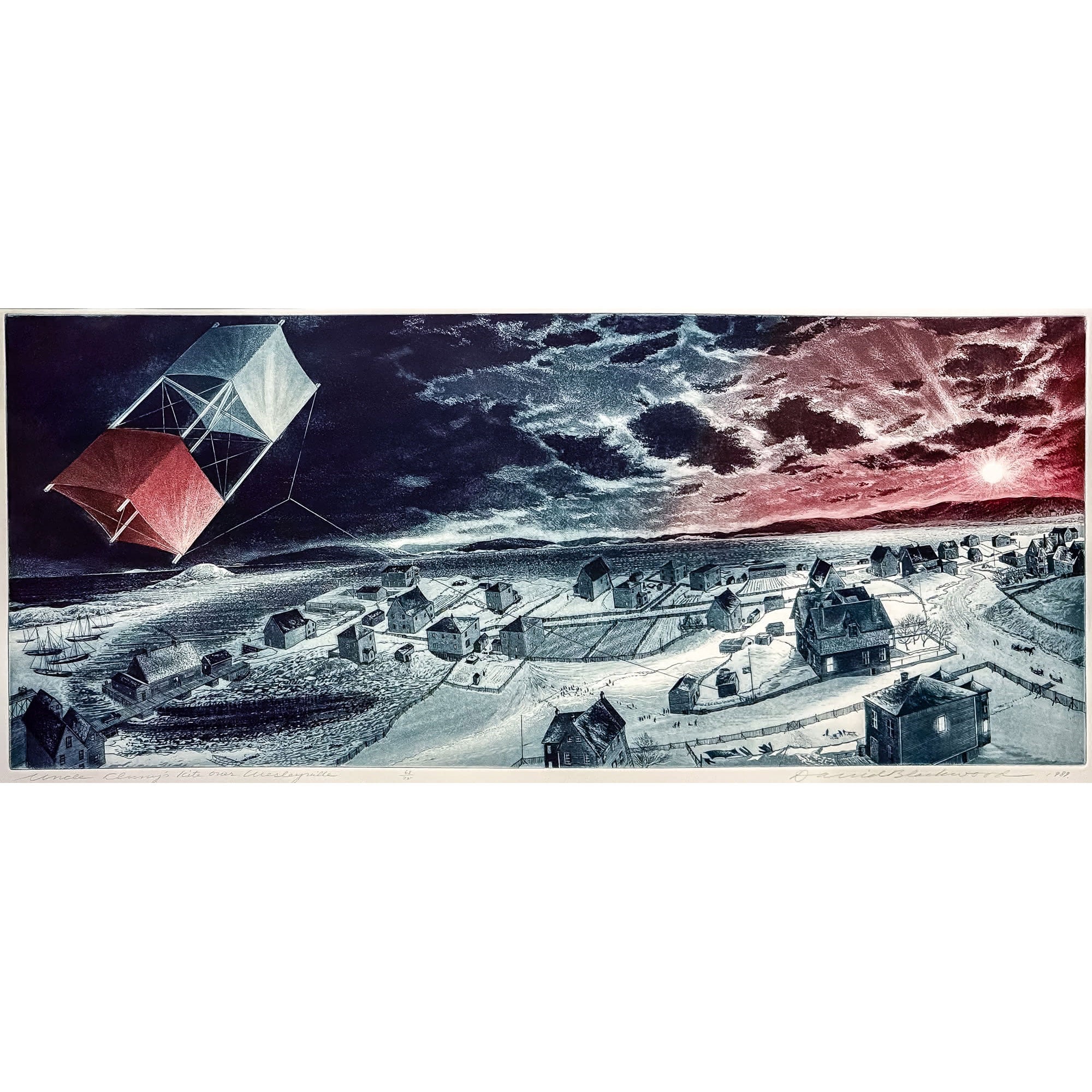
Uncle Cluny's Kite Over Wesleyville1989
Proudly Canadian
West End Gallery is a proudly Canadian business, celebrating the incredible talent of artists from coast to coast. For five decades, we have championed Canadian art and supported the vibrant creative community that makes this country extraordinary.
Edmonton, Alberta · Est. 1975
Founded in 1975, West End Gallery has been a cornerstone of Edmonton's arts community for five decades. Located in the heart of Alberta's capital, we take pride in our deep roots and our commitment to showcasing exceptional artwork from talented artists across Canada.
Uncle Cluny's Kite Over Wesleyville | 1989 | Etching 68 of 75
About the Artwork
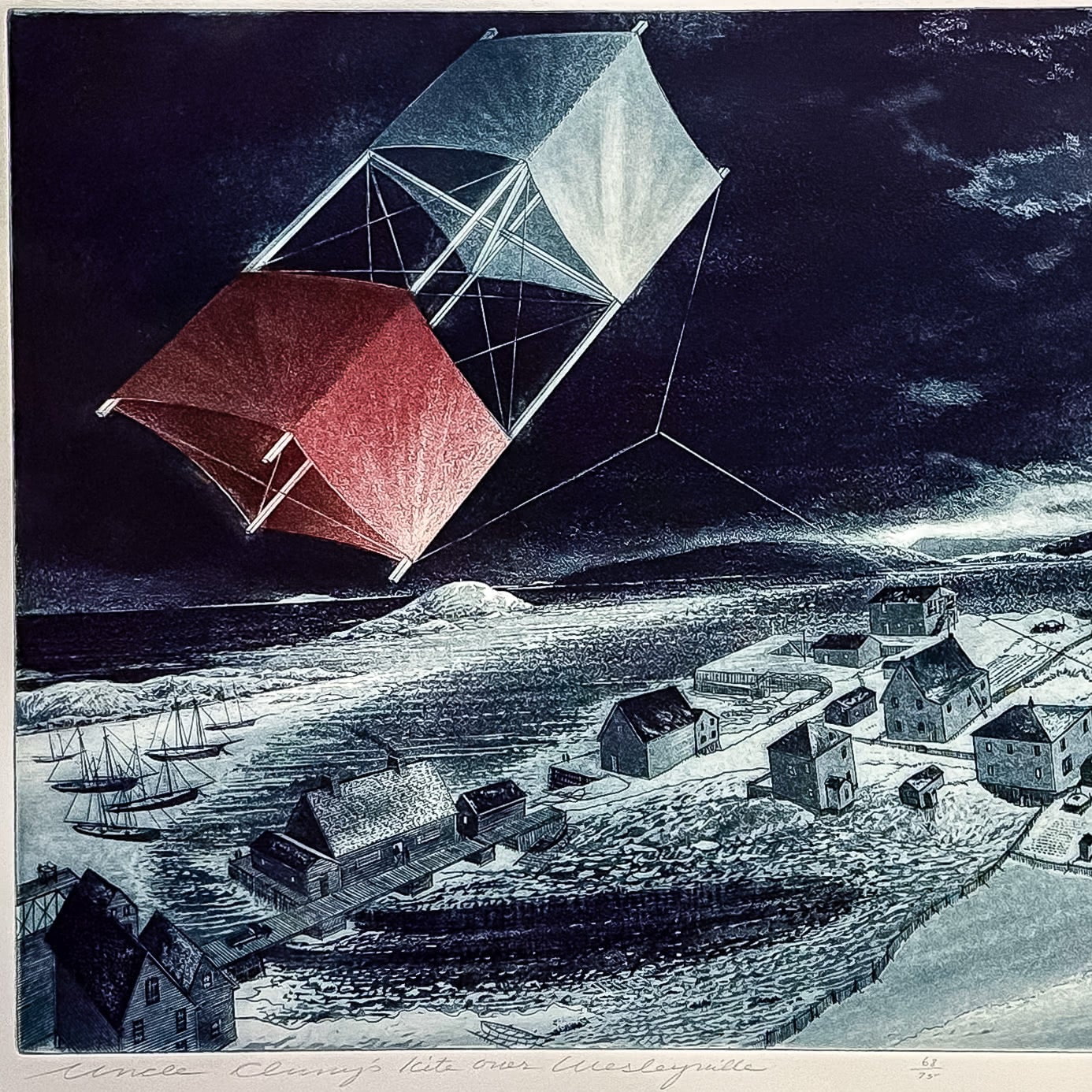
Uncle Cluny's Kite over Wesleyville (1989, 15" × 35½") is an etching and aquatint with selective hand-colouring by David Blackwood (1941–2022), presenting the entire village of Wesleyville in a single panoramic sweep. The composition extends across dozens of saltbox houses, picket fences, wharves, and the dark waters of the harbour, all seen from an elevated vantage point on the hillside. Scattered throughout the snow-covered streets, tiny figures walk with their dogs, stand in doorways, or go about their winter routines. In the upper left, a large box kite—hand-coloured in red-salmon tones—floats above the harbour, its white structural frame clear against the dramatic sky. Storm clouds sweep across the upper register, coloured in warm coral-pink and grey, with a red-pink glow breaking through on the right horizon. The kite hovers like a guardian spirit above the community, suspended between earth and sky, memory and present moment.
In Wesleyville culture, "Uncle" was an honorific title given to all male elders, regardless of blood relationship. As William Gough explains: "Older men were called 'Uncle,' no matter what the blood relationship, and older women were all called 'Aunt.' It didn't matter how bloodlines flowed: the world flowed everyone into the same ocean, where they were all related. Every person in a town was seen as being responsible for every other person."1 This means Uncle Cluny may not have been a blood relative at all—simply a respected elder in the community, one of the men who made kites or flew them with the children. The name itself is unusual; it may have been a nickname. Kite-flying in Wesleyville was more than recreation—it was craft, community ritual, and training for reading wind before boys went to the ice as sealers.
The panoramic format itself is exceptional in Blackwood's oeuvre. Where most of his prints are vertical or square, this composition stretches horizontally across 35½ inches, sweeping across the entire village. It is not a portrait of one house, one family, one event—it is a portrait of the whole place, with every roof and doorway part of the interconnected organism of Wesleyville life. The selective hand-colouring heightens emotional resonance: the warm red-pink kite and glowing sky create the warmth of memory against the cool grey-black aquatint used for the architecture, water, and snow. The composition captures not a single moment but the cumulative experience of living in this place—the dailiness of walking these roads, seeing the harbour, watching the sky, feeling oneself part of something larger than individual life.
Dimensions and Details
- Title: Uncle Cluny's Kite over Wesleyville
- Artist: David Blackwood (1941–2022)
- Year: 1989
- Size: 15" × 35½" (38.1 × 90.2 cm)
- Medium: Etching and aquatint with selective hand-colouring on paper
- Edition: 68/75
- Condition: Pristine. These specific impressions have been stored flat in archival conditions since 1989, never displayed or exposed to ambient light.
Acquisition Enquiries
Uncle Cluny's Kite over Wesleyville is offered exclusively through West End Gallery. Enquiries are welcome. We invite you to contact us directly to arrange a private viewing. Layaway options are available upon request. Shipping is quoted based on location; local delivery within Edmonton and surrounding communities is complimentary.
Citations
- William Gough, David Blackwood: Master Printmaker (Toronto: McGraw-Hill Ryerson, 2001).
Accessibility Description
This panoramic composition presents an elevated aerial view of Wesleyville, Newfoundland, spreading horizontally across an extreme 35½-inch width. The composition is densely populated with architectural and human detail. Dozens of two-storey saltbox houses with pitched roofs are scattered across the landscape, rendered in grey-black aquatint tones showing weathered clapboard siding. Wooden picket fences create geometric patterns throughout. Narrow paths and roads wind between houses, some traced by walking figures and dogs.
In the upper left, a large box kite dominates the sky—hand-coloured in red-salmon tones with a white structural frame clearly visible. The kite floats above the harbour on the left side of the composition, where dark water meets wharves and moored boats. The sky occupies substantial vertical space, showing dramatic storm clouds hand-coloured in warm coral-pink and salmon tones, contrasted with darker grey cloud masses. On the right horizon, a red-pink glow suggests sunset or breaking weather. Bare winter trees punctuate the landscape throughout.
Human figures—approximately thirty to forty individuals—are distributed across streets, yards, and pathways. Some are accompanied by dogs. All are rendered at tiny scale, emphasizing the panoramic scope. The harbour appears on the left, with schooners and fishing boats visible near the wharves. Snow covers the ground throughout. In the far distance, faint landmasses appear on the horizon—likely Cape Freels or offshore islands across Bonavista Bay.
The perspective suggests the view was taken from a hillside elevation, looking down and across the entire village layout. The hand-coloured red-salmon kite and warm pink sky create emotional warmth against the cool grey-black aquatint used for architecture, water, and snow. The composition captures the complete spatial and social structure of an outport community: houses, wharves, paths, harbour, ice, and sky unified in a single comprehensive image. The work is signed, titled, numbered (68/75), and dated by the artist. Medium: etching and aquatint with selective hand-colouring on paper, 15" × 35½" (38.1 × 90.2 cm).
Full Provenance
- 1989: Printed and hand-coloured by David Blackwood; edition of 75 published
- 1989–Present: Private collection; never displayed; stored in archival conditions; offered through West End Gallery, Edmonton
Disclaimer
This description has been prepared by West End Gallery using original documentation and current scholarship. The identity of "Uncle Cluny" remains under research; the honorific "Uncle" was a cultural title given to all male elders in Wesleyville, regardless of blood relationship. Whilst every effort has been made to ensure accuracy, minor variations or additional information may emerge through ongoing research. Prospective purchasers are encouraged to contact us to confirm any details critical to their acquisition decision.
Shipping & Exchanges
SHIPPING
All artwork is professionally crated and shipped via insured courier service. Shipping rates are calculated based on artwork dimensions and destination.
Delivery Methods:
• Local Pickup — Free at our Edmonton gallery (10337 124 Street NW)
• Local Delivery — complimentary within of Edmonton area
• Canada-wide Shipping — Canada Post, Canpar, Purolator or private courier
• US Shipping — DHL Express
• International & Overseas — DHL Express
Final shipping and handling costs will be confirmed with a quote before payment. Delivery times may vary due to weather, supply chain disruptions, or other factors beyond our control.
INSURANCE
Insurance coverage is not included in shipping estimates and is available upon request.
Exchange
We do not offer refunds, however we allow exchange or store credit within 72 hours of receipt, provided the artwork is returned in its original condition and packaging. Read more
Artwork Care
CARING FOR YOUR ARTWORK
Display
Hang artwork away from direct sunlight, heat sources, and air vents. UV exposure causes fading over time — UV-protective glazing is recommended for works on paper and photography. Avoid hanging artwork above fireplaces or in bathrooms where heat and humidity fluctuate.
Cleaning
Dust frames gently with a soft, dry cloth. Never use household cleaners, water, or solvents on the artwork surface. For oil paintings, a soft-bristle brush can be used lightly to remove surface dust. Professional cleaning is recommended for valuable or delicate pieces.
Temperature & Humidity
Maintain a stable environment — ideally 18–22°C (65–72°F) with 40–55% relative humidity. Rapid changes in temperature or humidity can cause warping, cracking, or flaking. In Alberta’s dry climate, a humidifier can help protect your collection during winter months.
Handling & Moving
Always handle artwork with clean, dry hands or cotton gloves. Carry framed works by the sides of the frame — never by the hanging wire. When transporting, wrap in acid-free tissue or soft blankets and keep upright. For valuable pieces, professional art handlers and custom crating are recommended.
Storage
Store artwork upright in a cool, dry, dark space. Use acid-free materials for wrapping. Never store artwork in attics, basements, or garages where temperature and humidity are uncontrolled.
Insurance
We recommend insuring your art collection. An up-to-date appraisal (every 2–3 years) ensures proper coverage. West End Gallery offers professional appraisal services — please enquire for details.
Questions?
Contact us at info@westendgalleryltd.com or 780-488-4892. We’re always happy to advise on the care of your collection.
Choose options

%20is%20an%20etching%20and%20aquatint%20with%20selective%20hand-colouring%20by%0A%20%20%20%20David%20Blackwood%20(1941%E2%80%93202...)