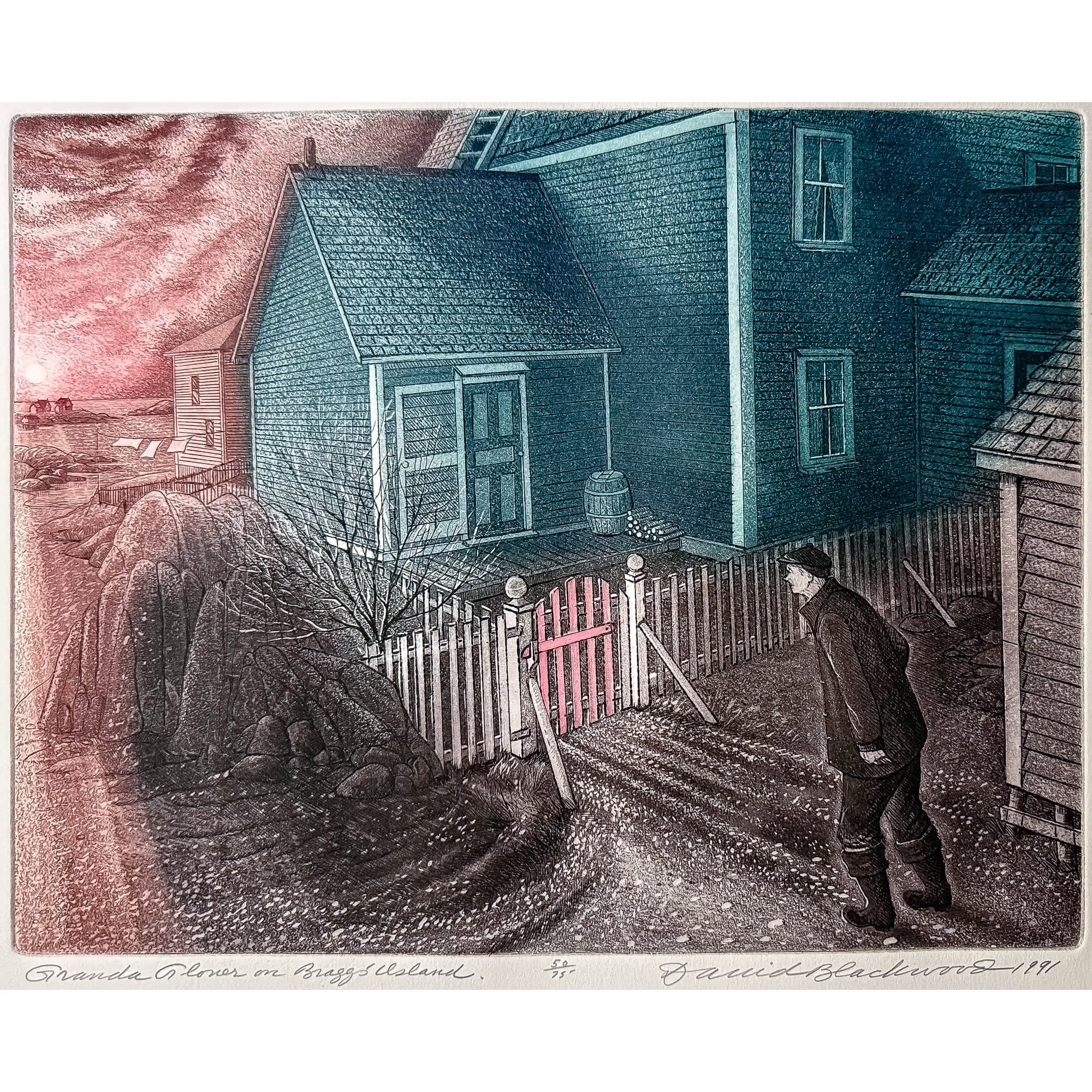
Granda Glover on Bragg's Island
1991
Etching with Aquatint on Paper
About the Artwork
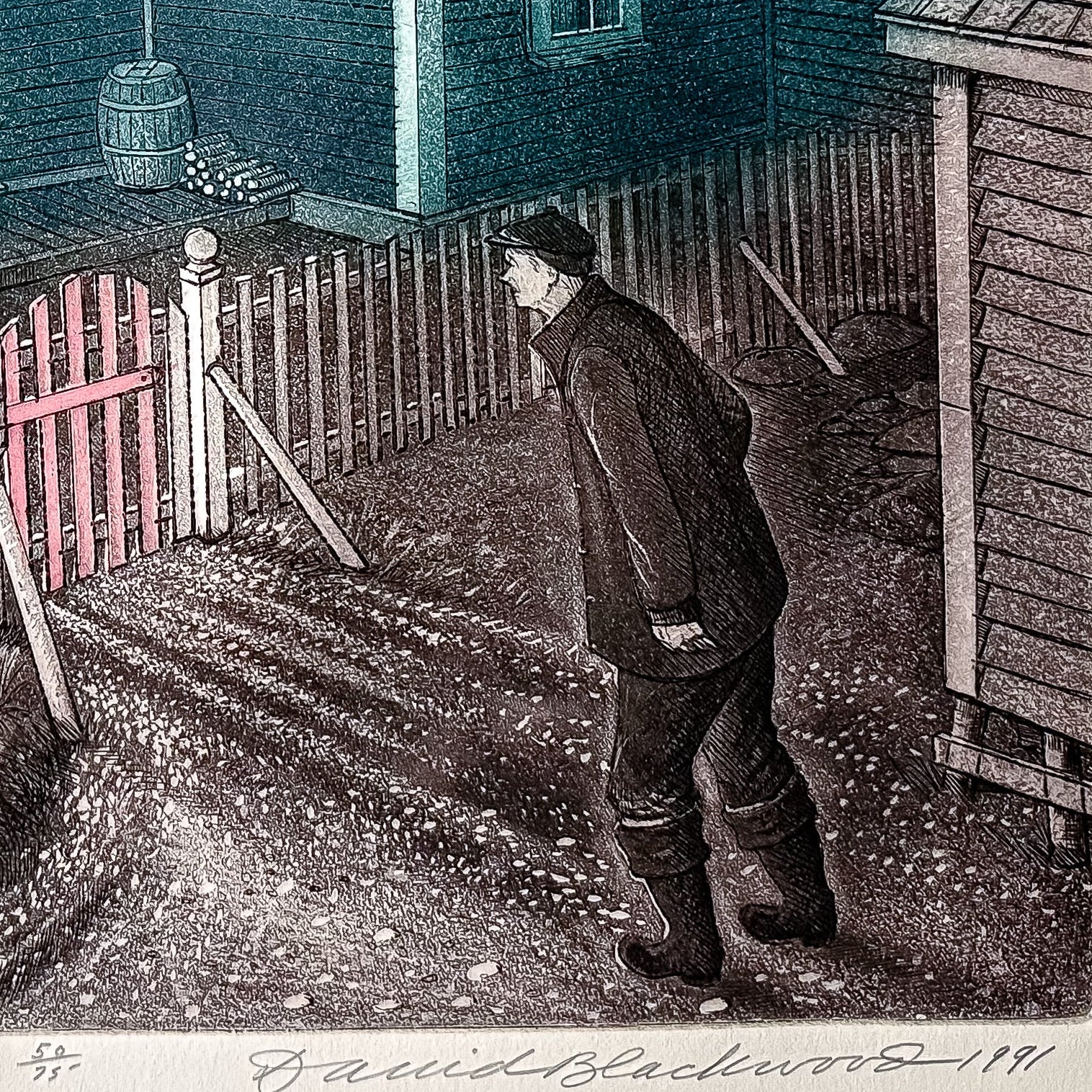
Granda Glover on Bragg's Island (1991) is an etching and aquatint with hand-colouring by David Blackwood (1941–2022), honouring his maternal grandfather, David Glover. The composition depicts an elderly man in dark work clothes walking down a sloping path toward the water, purposeful and determined. Behind a white picket fence—sections hand-coloured in coral-pink—stands the willow tree planted by his wife Alfreda, its delicate branches enclosed by protective fencing to keep sheep and goats away. The family house rises in the background, rendered in blue-grey and turquoise aquatint tones. The sky sweeps across the upper portion: coral-pink and rose clouds on the left transition to deep Prussian blue on the right, suggesting dawn or dusk—the times when Glover walked this path to haul his cod traps.
In an August 1991 letter to West End Gallery, Blackwood wrote:
"Granda Glover was my maternal Grandfather and lived on Bragg's Island about 16 miles out in Bonavista Bay. He was a cod trap fisherman all his life, even when he became a successful merchant supplying three local outport villages. The print shows him as I remember, in from hauling the trap, a daily ritual early every morning and late afternoon. The house is no longer there but the willow tree remains where my grandmother planted it. It was fenced around to protect it from sheep and goats."1
Like most Bonavista North men, he was involved with the seal hunt every spring, serving as a highly regarded Master Watch on the S.S. Eagle and S.S. Imogene.2
David Glover was fiercely independent, opposed to Newfoundland joining Canada. When Premier Joey Smallwood visited Bragg's Island, Glover refused to speak with him: "We're doing something important here, and I don't have time to waste on politicians." He built the family house high on the rocks—viridian green with yellow trim, a vibrant presence—with a big back kitchen where a man could remove his fishing gear before entering the main house, and distinctive diamond-shaped windows. When government resettlement forced the evacuation of Bragg's Island, Glover locked himself in his shed and wouldn't come out. His own son had to dismantle the house piece by piece.
William Gough records the aftermath:
"David Glover lived for years after that week, in a house in a growth centre. He sat and looked at the wall."3
Dimensions and Details
- Title: Granda Glover on Bragg's Island
- Artist: David Blackwood (1941–2022)
- Year: 1991
- Size: 11" × 14" (27.9 × 35.6 cm)
- Medium: Etching and aquatint with hand-colouring on paper
- Edition: 50/75
- Condition: Pristine. These specific impressions have been stored flat in archival conditions since 1991, never displayed or exposed to ambient light.
Acquisition Enquiries
Granda Glover on Bragg's Island is offered exclusively through West End Gallery. Enquiries are welcome. We invite you to contact us directly to arrange a private viewing. Layaway options are available upon request. Shipping is quoted based on location; local delivery within Edmonton and surrounding communities is complimentary.
Citations
- David Blackwood, letter to West End Gallery, August 12, 1991. West End Gallery Archive.
- David Blackwood, artist's statement for Notes from Bragg's Island triptych, Port Hope, October 1992. West End Gallery Archive.
- William Gough, David Blackwood: Master Printmaker (Toronto: McGraw-Hill Ryerson, 2001).
Accessibility Description
The composition shows David Glover walking down a path on Bragg's Island. On the right side of the foreground, an elderly man in dark work clothes and cap walks along a sloping path toward the water, his body leaning forward with purposeful movement. The path and surrounding ground are rendered in warm earth tones—reddish-brown, coral-pink, and ochre hand-colouring over etched grey-black lines suggesting rocky terrain.
A white picket fence with vertical slats crosses the middle ground, with sections hand-coloured in coral-pink tones. On the left side, behind this fence, stands the willow tree planted by his wife Alfreda, its delicate branches spreading upward, enclosed by protective fencing to keep sheep and goats away. Behind the fence, the family house rises—a clapboard-sided structure with peaked roof rendered in blue-grey and turquoise aquatint tones. Additional outbuildings appear to the right. The sky dominates the upper portion: sweeping clouds hand-coloured in coral-pink and rose on the left transition to deep Prussian blue on the right, suggesting dawn or dusk—the times when Glover walked this path to haul his cod traps.
The overall palette combines hand-coloured warm tones (coral-pinks, earth reds, ochres) with cool blue-grey aquatint (buildings and sky). The work is signed "David Blackwood—1991" in the lower margin. Medium: etching and aquatint with hand-colouring on paper, 11" × 14" (27.9 × 35.6 cm).
Full Provenance
- 1991: Created by David Blackwood
- 1991: Edition of 75 published
- 1991–Present: Private collection; never displayed; stored in archival conditions; offered through West End Gallery, Edmonton
Disclaimer
This description has been prepared by West End Gallery using original documentation and current scholarship. Whilst every effort has been made to ensure accuracy, minor variations or additional information may emerge through ongoing research. Prospective purchasers are encouraged to contact us to confirm any details critical to their acquisition decision.
Proudly Canadian
West End Gallery is a proudly Canadian business, celebrating the incredible talent of artists from coast to coast. For five decades, we have championed Canadian art and supported the vibrant creative community that makes this country extraordinary.
Edmonton, Alberta · Est. 1975
Founded in 1975, West End Gallery has been a cornerstone of Edmonton's arts community for five decades. Located in the heart of Alberta's capital, we take pride in our deep roots and our commitment to showcasing exceptional artwork from talented artists across Canada.
Shipping & Exchanges
Shipping
Artwork is carefully packed in a suitable box or crate. Shipping and handling are quoted for the artwork and destination and confirmed before payment.
Delivery methods
- Local pickup — free at 10337 124 Street NW, Edmonton.
- Local delivery — complimentary within Edmonton.
- Canada-wide shipping — Canada Post, Canpar, Purolator or private courier.
- US and international shipping — DHL Express.
Delivery times may vary due to weather, carrier delays and other factors beyond our control.
Carrier coverage and additional insurance
Artwork ships with the basic coverage included by the carrier. This coverage is subject to the carrier’s terms and limits and may not cover the full value of the artwork. Clients may arrange additional insurance themselves or ask the Gallery for a quote for coverage under the Gallery’s policy before shipment.
Exchanges
Ordinary goods are final sale, except where required by law. The Gallery may, at its discretion, offer an exchange or store credit; a request does not guarantee approval.
Request a discretionary exchange in writing within seven calendar days of the invoice or Bill of Sale date for in-gallery purchases, or within seven calendar days of delivery for shipped purchases within Canada or internationally. Obtain authorization before returning goods. Approved returns must meet the condition, documentation and packaging requirements in our Return & Exchange Policy.
Gift certificates, commissions, special orders and layaway/payment-plan purchases are excluded from the ordinary discretionary exchange policy. Separately agreed terms and statutory rights remain unaffected. The accepted quote and accompanying terms govern your transaction; later website updates do not change an existing agreement.
Damage reporting
Inspect the artwork and packaging promptly. Report damage or discrepancies as soon as possible, preferably within 48 hours of delivery or pickup, with available photographs of the artwork, packaging and shipping label. Retain all packaging while the issue is investigated. Missing this requested reporting period does not by itself remove statutory rights. Carrier and insurer requirements depend on the actual service or policy. Read our Return & Exchange Policy.
Artwork Care
CARING FOR YOUR ARTWORK
Display
Hang artwork away from direct sunlight, heat sources, and air vents. UV exposure causes fading over time — UV-protective glazing is recommended for works on paper and photography. Avoid hanging artwork above fireplaces or in bathrooms where heat and humidity fluctuate.
Cleaning
Dust frames gently with a soft, dry cloth. Never use household cleaners, water, or solvents on the artwork surface. For oil paintings, a soft-bristle brush can be used lightly to remove surface dust. Professional cleaning is recommended for valuable or delicate pieces.
Temperature & Humidity
Maintain a stable environment — ideally 18–22°C (65–72°F) with 40–55% relative humidity. Rapid changes in temperature or humidity can cause warping, cracking, or flaking. In Alberta’s dry climate, a humidifier can help protect your collection during winter months.
Handling & Moving
Always handle artwork with clean, dry hands or cotton gloves. Carry framed works by the sides of the frame — never by the hanging wire. When transporting, wrap in acid-free tissue or soft blankets and keep upright. For valuable pieces, professional art handlers and custom crating are recommended.
Storage
Store artwork upright in a cool, dry, dark space. Use acid-free materials for wrapping. Never store artwork in attics, basements, or garages where temperature and humidity are uncontrolled.
Insurance
We recommend insuring your art collection. An up-to-date appraisal (every 2–3 years) ensures proper coverage. West End Gallery offers professional appraisal services — please enquire for details.
Questions?
Contact us at info@westendgalleryltd.com or 780-488-4892. We’re always happy to advise on the care of your collection.
Choose options

