Cyril's Kite over Blackwoods HillEtching 67 of 75
Proudly Canadian
West End Gallery is a proudly Canadian business, celebrating the incredible talent of artists from coast to coast. For five decades, we have championed Canadian art and supported the vibrant creative community that makes this country extraordinary.
Edmonton, Alberta · Est. 1975
Founded in 1975, West End Gallery has been a cornerstone of Edmonton's arts community for five decades. Located in the heart of Alberta's capital, we take pride in our deep roots and our commitment to showcasing exceptional artwork from talented artists across Canada.
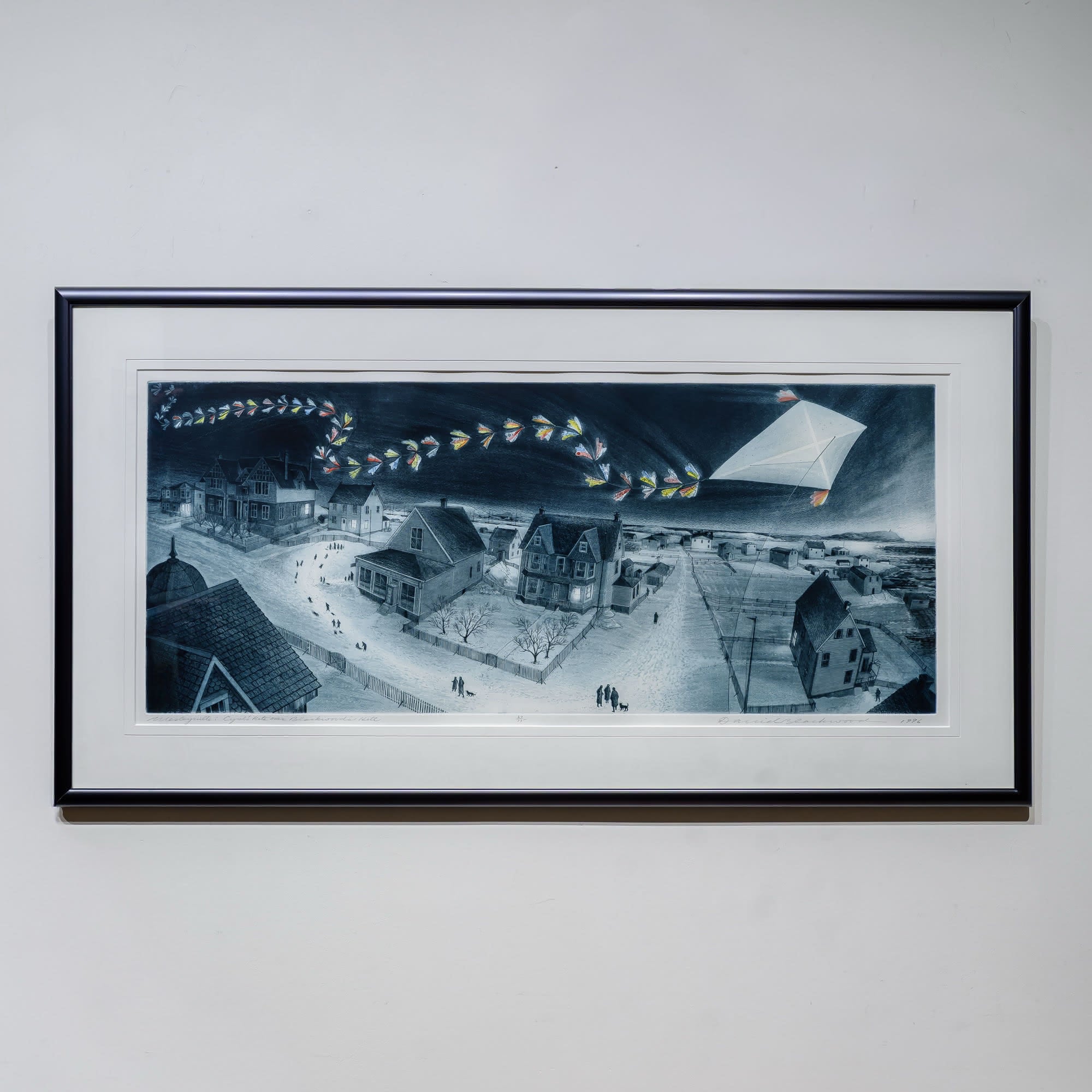
Cyril's Kite over Blackwoods Hill | Etching 67 of 75
About the Artwork
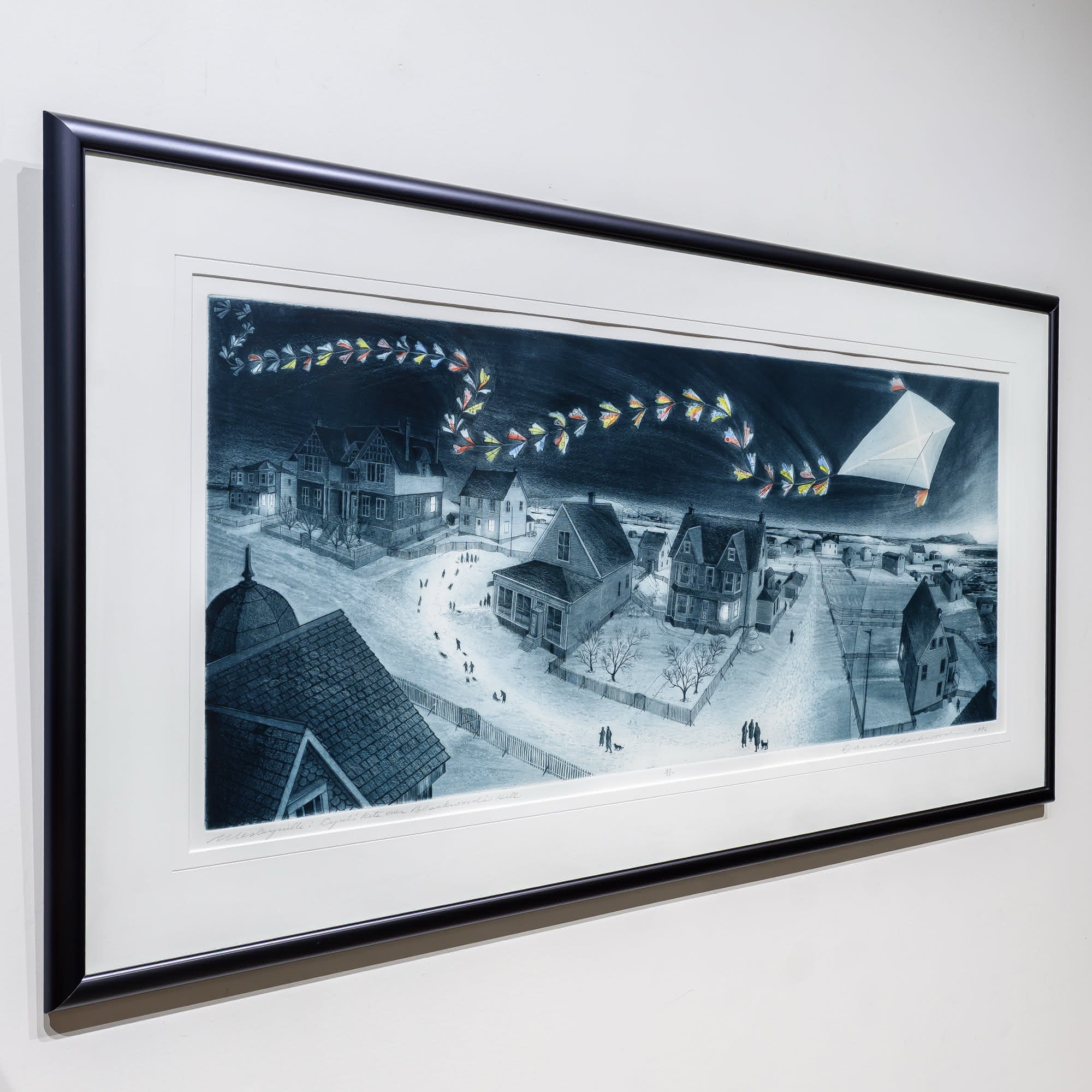
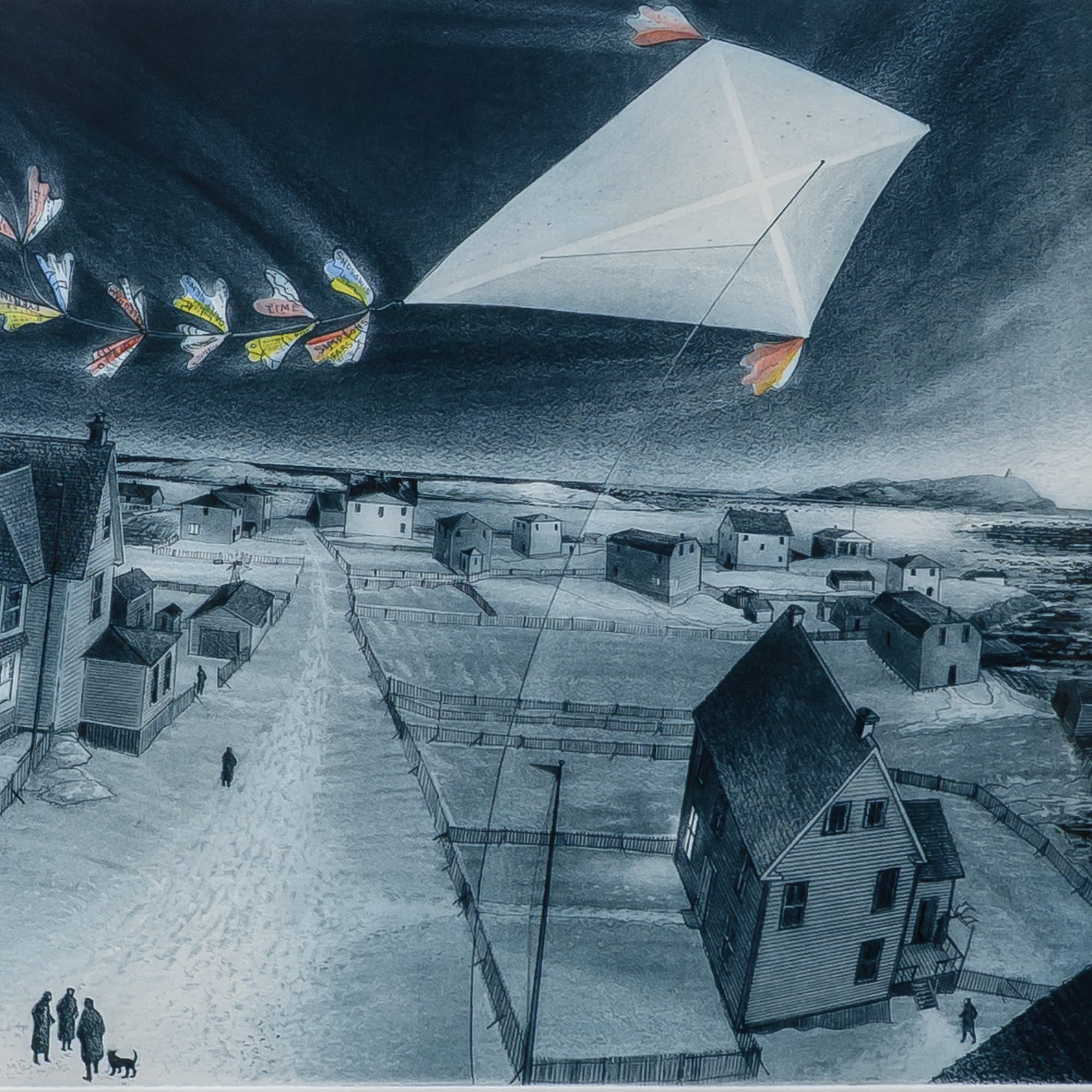
Cyril's Kite over Blackwood's Hill is a 15" × 36" colour etching and aquatint by David Blackwood RCA (1941–2022), edition 67/75. Set in Wesleyville, Newfoundland, the composition gathers the houses and topography of Blackwood's childhood street, viewed from the rise he called Blackwood's Hill. A white kite arcs across the twilight sky, its long tail sweeping in a curve of bright colour—made, as Blackwood noted, from "rolled up pages of Eaton's / Simpson's catalogues."1
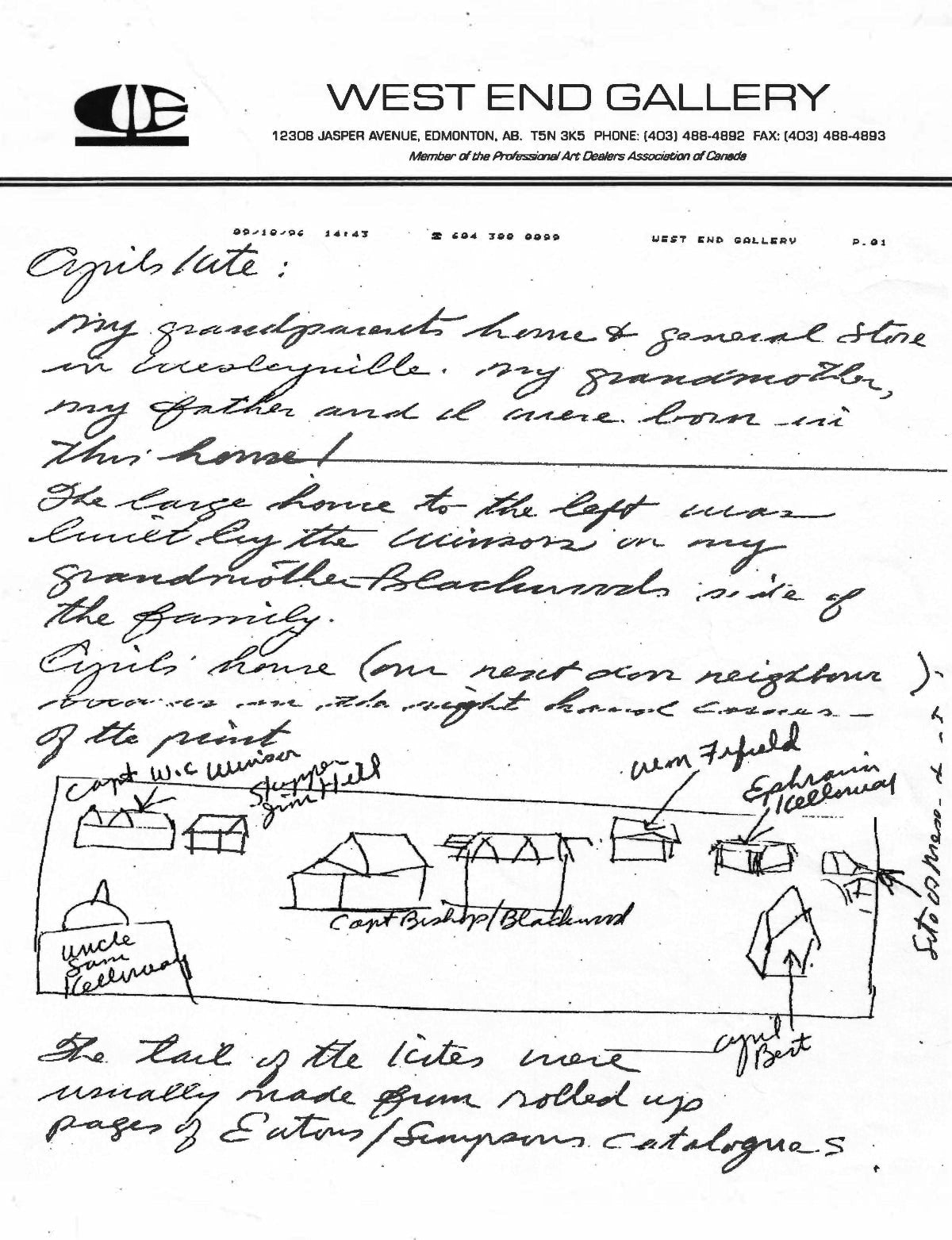
The homes are all real. In a 1996 letter to West End Gallery, Blackwood identified each one and drew a map of the street.1 At the centre stands the house marked "Capt Bishop / Blackwood"—his grandparents' home and general store. "My grandmother, my father and I were born in this home!" he wrote. To the left, the large house was "built by the Winsors on my grandmother Blackwood's side of the family." Reading left to right across the composition: Uncle Sam Kelloway, Capt W.C. Winsor, Skipper Jim Hill, the Blackwood house, William Fifield, Ephraim Kelloway, and finally Cyril Best—"our next door neighbour"—whose kite gives the print its title. The far right points toward St. Coleman's.
The Kelloway houses held lasting importance in Blackwood's art. In a 1990 artist's statement, he recalled the brothers Alphus, Jacob, and Ephraim Kelloway as "the next door neighbours of my childhood." While the community was known for brightly painted houses, the Kelloway place was "known for its greyness"—a weathered grey clapboard house that "had not been painted in living memory." Yet for several summers in the mid-1950s, Ephraim Kelloway painted his barn door "some say fifty times": whitewash, then black, yellow, brown, red, blue, stovepipe silver, and "bed room" pink, eventually adding "a variety of hinges, a horseshoe, a half model of a boat and cutouts of brightly coloured and lettered tin."2 That memory inspired the etching Ephraim Kelloway's Door (1981) and reappeared in Passing Shadow (1990). The same neighbourhood re-emerges here in Cyril's Kite, uniting a lifetime of imagery rooted in community, memory, and the ordinary made luminous. The work rewards extended viewing.
Dimensions and Details
- Title: Cyril's Kite over Blackwood's Hill
- Artist: David Blackwood RCA (1941–2022)
- Year: 1996
- Size: 15" × 36" (38.1 × 91.4 cm) plate
- Medium: Colour etching and aquatint on paper
- Edition: 67/75
- Condition: Excellent; professionally framed and archivally presented
Exceptional Archival Documentation
This artwork has been cross-referenced with original archival materials in the West End Gallery collection:
- Handwritten letter from David Blackwood identifying each home in the composition (1996)
- Hand-drawn map by the artist locating the houses on Blackwood's Hill
- Artist's statement from Station Art Gallery 20th Anniversary Exhibition (1990) recounting the story of Ephraim Kelloway's painted barn door
These documents provide rare insight into the autobiographical sources of Blackwood's Wesleyville imagery and allow the collector to narrate this work with the artist's own words.
Citations
- David Blackwood, handwritten letter and map to West End Gallery, 1996. West End Gallery Archives. Transcription: "Cyril's Kite: My grandparents home & general store in Wesleyville. My grandmother, my father and I were born in this home! The large house to the left was built by the Winsors on my grandmother Blackwood's side of the family. Cyril's house (our next door neighbour) was on the right hand corner of the print. The tail of the kites were usually made from rolled up pages of Eaton's / Simpson's catalogues."
- David Blackwood, artist's statement, Station Art Gallery 20th Anniversary Exhibition, 1990. West End Gallery Archives. Transcription excerpt: "The brothers, Alphus, Jacob and Ephraim Kelloway, were the next door neighbours of my childhood. In our community of brightly painted houses the Kelloway 'place' was known for its greyness. This weathered grey clapboard house, perched high on a granite rock and surrounded by grey outbuildings, had not been painted in living memory. However, for several summers in the mid fifties, Ephraim Kelloway painted his barn door – some say fifty times. This painting started off in a typical manner, the door was quite simply whitewashed or 'limed'. Soon, however, Ephraim Kelloway's door went through a succession of remarkable changes. Ephraim Kelloway painted his door black, then yellow, brown, red, blue, stovepipe silver and a 'bed room' pink. When he had exhausted the effects of individual colours he began to explore combinations. In addition to this he had taken to embellishing the surface further with a variety of hinges, a horseshoe, a half model of a boat and cutouts of brightly coloured and lettered tin."
Accessibility Description
A panoramic horizontal composition depicting a winter twilight view of Wesleyville, Newfoundland, seen from an elevated hillside. The format is notably wide—15 inches tall by 36 inches across—emphasising the sweep of the townscape below.
The palette is predominantly deep blue-grey and white, evoking a cold winter evening. Rows of wooden houses with peaked roofs descend the snow-covered hillside toward a distant harbour. The largest house, positioned near the centre, features a prominent peaked roof—this is the Blackwood family home and general store. Fences, outbuildings, and bare trees punctuate the spaces between homes. Small figures are visible: a group gathered near the central house, and in the lower right foreground, people walking with a dog.
A white diamond-shaped kite floats in the upper right portion of the sky, emitting a warm pinkish glow at its centre. Its tail sweeps in a long arc from the kite across to the upper left of the composition, composed of dozens of small bow-shaped elements in bright pinks, yellows, greens, and blues—the rolled catalogue pages described by the artist. On the far right horizon, a low landmass sits across the harbour in the direction of St. Coleman's. The overall mood is quiet and nostalgic, the colourful kite tail providing the only warm tones against the cool blue-grey winter scene.
Full Provenance
- 1996: Created by David Blackwood, Port Hope, Ontario
- 1996: Acquired directly by West End Gallery Ltd., Edmonton, Alberta
- 1996–Present: West End Gallery inventory
Disclaimer
This description has been prepared by West End Gallery using original archival correspondence and current scholarship. Whilst every effort has been made to ensure accuracy, minor variations or additional information may emerge through ongoing research. Prospective purchasers are encouraged to contact us to confirm any details critical to their acquisition decision.
© 2025 West End Gallery Ltd. All rights reserved. Primary source materials © archival correspondence from David Blackwood. Reproduction or redistribution without written permission is prohibited.
Shipping & Exchanges
SHIPPING
All artwork is professionally crated and shipped via insured courier service. Shipping rates are calculated based on artwork dimensions and destination.
Delivery Methods:
• Local Pickup — Free at our Edmonton gallery (10337 124 Street NW)
• Local Delivery — complimentary within of Edmonton area
• Canada-wide Shipping — Canada Post, Canpar, Purolator or private courier
• US Shipping — DHL Express
• International & Overseas — DHL Express
Final shipping and handling costs will be confirmed with a quote before payment. Delivery times may vary due to weather, supply chain disruptions, or other factors beyond our control.
INSURANCE
Insurance coverage is not included in shipping estimates and is available upon request.
Exchange
We do not offer refunds, however we allow exchange or store credit within 72 hours of receipt, provided the artwork is returned in its original condition and packaging. Read more
Artwork Care
CARING FOR YOUR ARTWORK
Display
Hang artwork away from direct sunlight, heat sources, and air vents. UV exposure causes fading over time — UV-protective glazing is recommended for works on paper and photography. Avoid hanging artwork above fireplaces or in bathrooms where heat and humidity fluctuate.
Cleaning
Dust frames gently with a soft, dry cloth. Never use household cleaners, water, or solvents on the artwork surface. For oil paintings, a soft-bristle brush can be used lightly to remove surface dust. Professional cleaning is recommended for valuable or delicate pieces.
Temperature & Humidity
Maintain a stable environment — ideally 18–22°C (65–72°F) with 40–55% relative humidity. Rapid changes in temperature or humidity can cause warping, cracking, or flaking. In Alberta’s dry climate, a humidifier can help protect your collection during winter months.
Handling & Moving
Always handle artwork with clean, dry hands or cotton gloves. Carry framed works by the sides of the frame — never by the hanging wire. When transporting, wrap in acid-free tissue or soft blankets and keep upright. For valuable pieces, professional art handlers and custom crating are recommended.
Storage
Store artwork upright in a cool, dry, dark space. Use acid-free materials for wrapping. Never store artwork in attics, basements, or garages where temperature and humidity are uncontrolled.
Insurance
We recommend insuring your art collection. An up-to-date appraisal (every 2–3 years) ensures proper coverage. West End Gallery offers professional appraisal services — please enquire for details.
Questions?
Contact us at info@westendgalleryltd.com or 780-488-4892. We’re always happy to advise on the care of your collection.
Choose options

,%20edition%2067/75.%20Set%20in%20Wesleyville,%20Newfoundland,%20the%20com...)